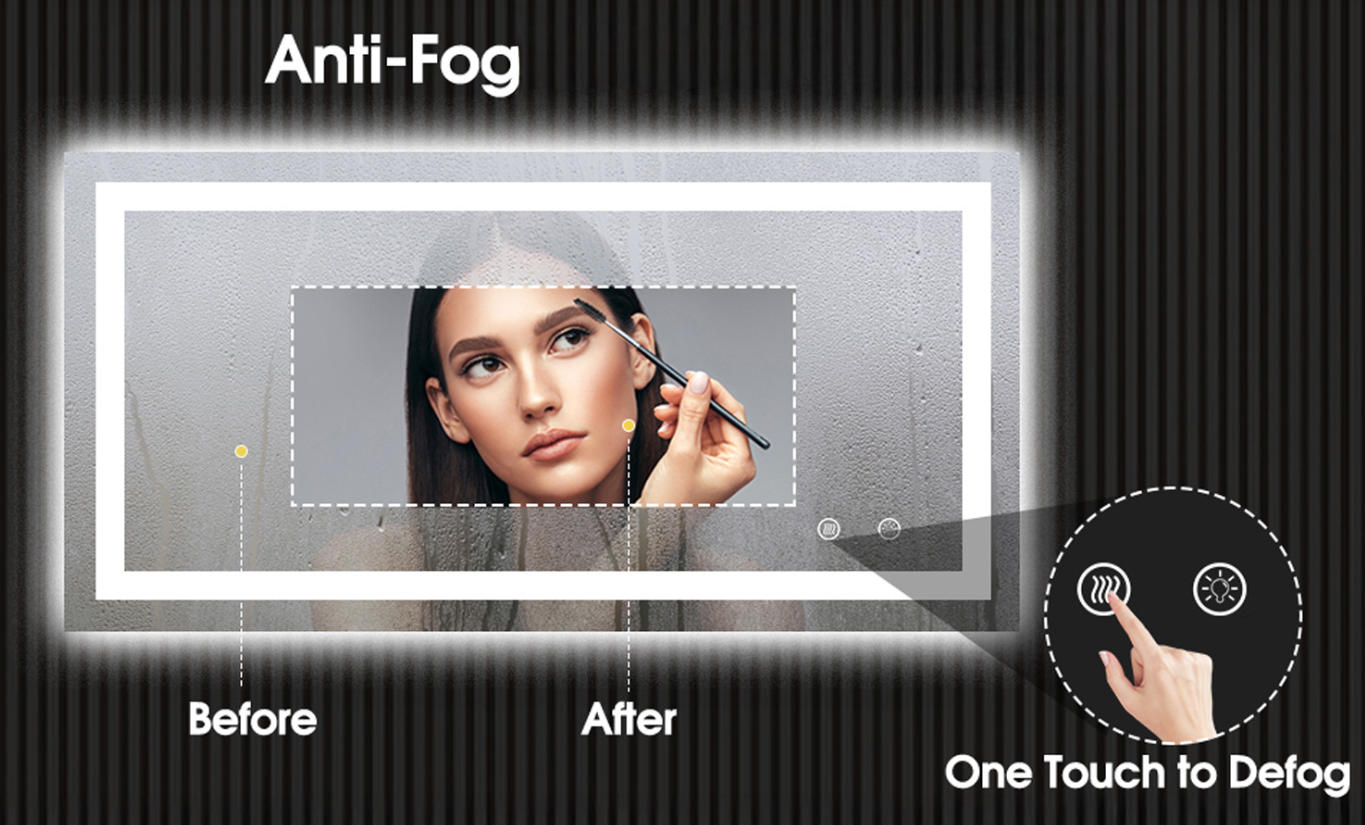
A steamed-up mirror after a hot shower is a common frustration. Just when you’re ready to do your skincare routine or style your hair, the mirror surface clouds over, forcing you to wipe it down repeatedly. That’s why LED anti-fog mirrors have become an essential upgrade in modern bathrooms — combining style, technology, and convenience.
Let’s explore how mirror fog forms, how anti-fog technology works, and what to consider when choosing the best LED anti-fog mirror for your home.
Why Does a Bathroom Mirror Fog Up?
Fog appears when warm, moist air from a shower meets the cooler surface of the mirror. The water vapor condenses into tiny droplets, forming a misty layer that blocks visibility.
In winter, when the temperature difference between the air and the mirror is larger, the fog becomes even thicker and takes longer to clear naturally.
The most direct way to prevent this is to either warm up the mirror surface or prevent condensation from forming at all — which is where anti-fog technology comes in.
Why Do You Need an LED Anti-Fog Mirror?
Beyond convenience, an anti-fog mirror improves your overall bathroom experience. It ensures that you always have a clear, well-lit reflection — perfect for makeup application, shaving, or simply getting ready in the morning.
Many ordinary mirrors with LED decorations only provide soft ambient light and fail to offer proper brightness or color accuracy for grooming tasks. A well-designed LED anti-fog mirror solves both problems: it provides balanced lighting and keeps your reflection crystal clear, even in steamy conditions.
How Does Anti-Fog Technology Work?
There are several different methods used to achieve the anti-fog effect, each with its own advantages and lifespan.
1. Coated Anti-Fog Mirrors
These mirrors use a thin hydrophilic coating made from conductive materials such as ATO and silicon oxide. The coating helps water spread evenly across the surface instead of forming droplets, maintaining a clearer view.
Although this method is eco-friendly and effective at first, the coating typically wears off over time, reducing its long-term performance.
2. Electrically Heated Anti-Fog Mirrors
This is the most common and effective solution in modern LED mirrors. A heating pad installed behind the glass gently warms the mirror surface, reducing the temperature difference that causes condensation.
When turned on, it prevents fog from forming — or clears existing fog within minutes. However, it’s important that the heating power is precisely controlled. Excessive or rapid heating can damage the mirror or cause cracking, which is why quality manufacturing makes a big difference.
3. Nano-Composite Anti-Fog Mirrors
This newer technology uses nano-material coatings that bond tightly to the glass surface, altering its molecular structure so water cannot form droplets. Instead, moisture spreads into an invisible thin layer. This provides long-lasting fog prevention with excellent clarity, although it’s more complex and costly to produce.
How to Choose the Best LED Anti-Fog Mirror
When selecting an LED anti-fog mirror for your bathroom, consider these key factors:
Heating efficiency – Look for mirrors that heat evenly and safely.
Light quality – Choose adjustable LED lighting that mimics natural daylight for accurate makeup or grooming.
Durability and safety – A good mirror should be waterproof, energy-efficient, and meet safety standards for use in humid environments.
Smart features – Additional functions like touch control, temperature display, and Bluetooth speakers can further enhance your experience.
Clear Vision, Every Time
In essence, the best anti-fog solution comes from combining intelligent heating with quality glass and lighting.
At STANHOM, our LED anti-fog mirrors are designed with safety, performance, and aesthetics in mind — giving you a consistently clear view, no matter how steamy your bathroom gets.
Still unsure which type fits your needs?
Feel free to contact our team — we’ll help you choose the perfect LED anti-fog mirror for your space.